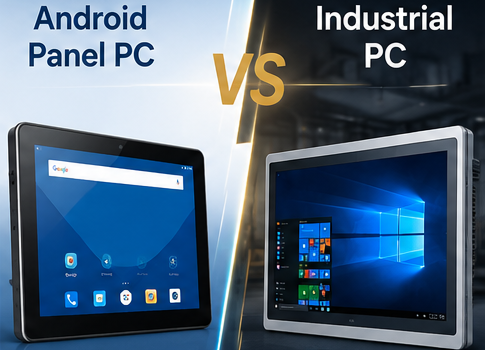
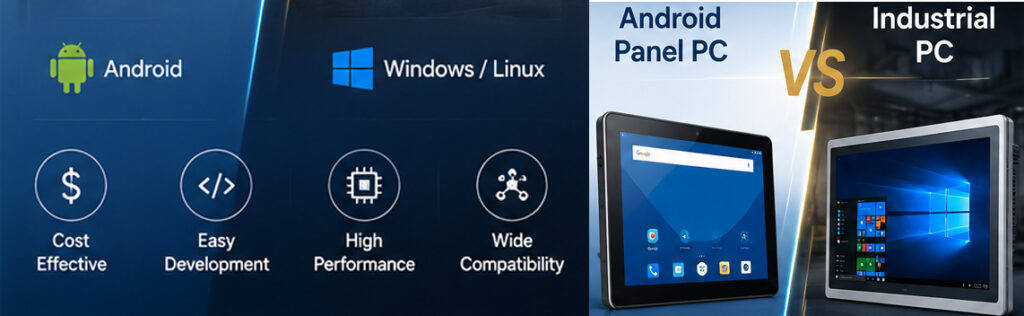
Both Android Panel PCs and Industrial PCs are commonly used in commercial and industrial applications. Understanding their differences helps system integrators choose the most suitable solution.
Android Panel PC
An Android Panel PC combines:
- Display
- Touchscreen
- Android operating system
- Embedded processor
into a single device.
Advantages:
✓ Lower cost
✓ Easy deployment
✓ Fast development
✓ Low power consumption
✓ Excellent for kiosk applications
Typical applications:
- Self-service kiosks
- Smart lockers
- Meeting room booking systems
- Retail POS terminals
- Digital signage
Industrial PC
Industrial PCs typically run:
- Windows
- Linux
Advantages:
✓ Higher computing power
✓ Legacy software compatibility
✓ Extensive peripheral support
✓ Advanced industrial control applications
Typical applications:
- Machine automation
- Vision inspection systems
- SCADA systems
- Factory control systems
Comparison
| Feature | Android Panel PC | Industrial PC |
|---|---|---|
| Cost | Lower | Higher |
| Power Consumption | Lower | Higher |
| Development Time | Faster | Longer |
| Windows Software | No | Yes |
| Industrial Control | Basic | Advanced |
| Maintenance | Easier | More Complex |
Conclusion
If your application focuses on user interaction, kiosk systems, retail, or digital signage, Android Panel PCs are often the most cost-effective solution.
For advanced industrial automation and Windows-based software environments, Industrial PCs remain the preferred choice.